Discover six preserved medieval fortress towns in Portugal and learn how to easily link them into a smooth, multi-day itinerary.
1. Obidos, the classic whitewashed fortress on the Silver Coast
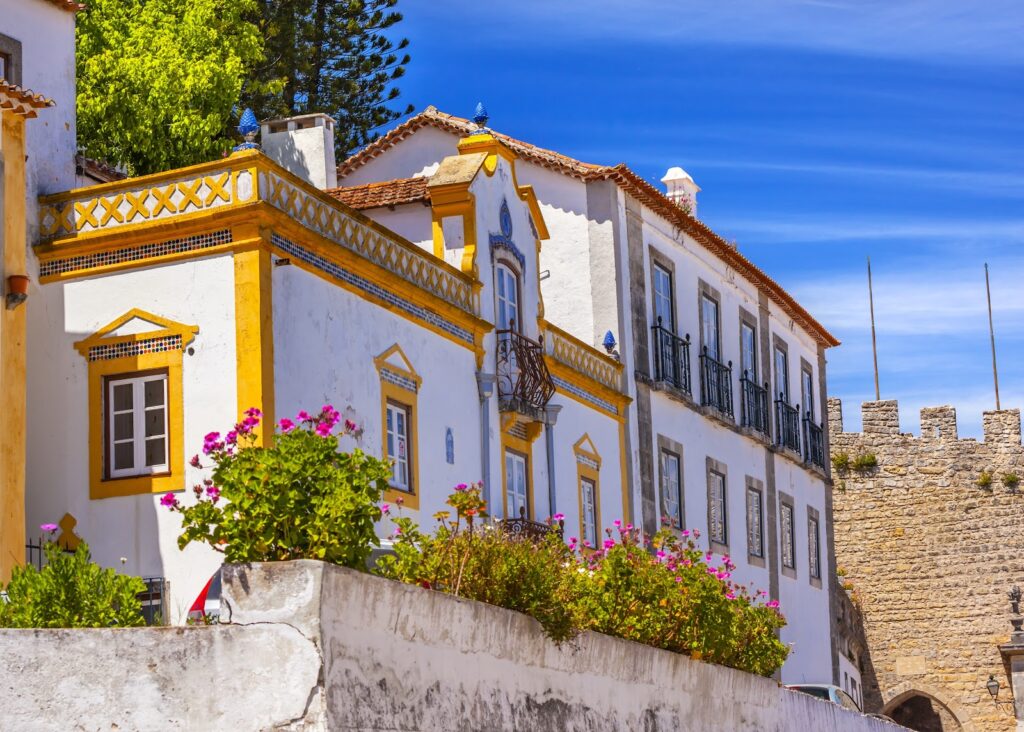
Just over an hour north of Lisbon, Obidos offers American travelers an effortless first taste of Portugal fortified heritage. King Dinis gifted this town to Queen Isabel in the thirteenth century, establishing a royal tradition that kept its ramparts, Gothic doorways, and cobbled lanes remarkably intact. Walking the complete circuit of the twelfth-century crenellated walls provides sweeping views over surrounding vineyards and olive orchards. Inside the gates, whitewashed cottages framed in vibrant blue and yellow paint host artisan bookshops, bakeries serving warm regional pastries, and small taverns pouring sour cherry liqueur, known as ginjinha, served inside tiny edible chocolate cups.
Because Obidos sits directly along the central highway corridor, it serves as a natural morning stop on a broader multi-day route connecting Lisbon to historic Coimbra or Porto. Exploring with a local driver and guide lets travelers bypass the crowded midday tour buses, stepping into town during quiet morning light while luggage stays secure in a Mercedes-Benz vehicle. Pair a morning walk along the ramparts with a quiet seaside lunch in nearby Nazare or Foz do Arelho before heading farther into the central provinces.
2. Marvao, an eagle nest fortress overlooking the Spanish frontier
Perched nearly three thousand feet above sea level on a rugged granite ridge in the upper Alentejo, Marvao feels like an eagle nest suspended between Portugal and Spain. The town walls, reinforced by medieval monarchs and Knights Hospitaller, blend organically into the sheer cliffs, creating a nearly impenetrable defense. Inside, the quiet streets are paved in local quartz and lined with Gothic arched entryways and wrought-iron balconies blooming with red geraniums. From the castle keep, panoramic vistas stretch endlessly across the Serra de Sao Mamede Natural Park and into neighboring Extremadura.
Marvao combines seamlessly into a three-day or four-day eastern route paired with the historic city of Evora and the neighboring Roman ruins of Ammaia. American travelers accustomed to the steep challenges of mountain driving in rural France or Italy appreciate having a dedicated driver handle the hairpin curves leading to the village gates. After an afternoon walk on the ramparts, settle into a traditional restaurant for roasted kid with chestnuts, paired with bold, full-bodied Alentejo red wines that provide exceptional quality at a fraction of Napa or Tuscan prices.
3. Monsaraz, whitewashed tranquility above the Alqueva waters
Rising dramatically above the plains of the eastern Alentejo, Monsaraz stands as one of the oldest settlements in southern Portugal. Reconquered from Moorish forces in the twelfth century and later granted to the Knights Templar, this village remains completely pedestrianized, paved with dark slate stones that contrast against pristine white houses. At the southern tip of the ridge, the medieval castle houses an ancient arena that looks out over the vast, shimmering surface of the Alqueva reservoir, the largest artificial lake in Western Europe.
Monsaraz fits effortlessly into a multi-day itinerary focused on southern Portugal history and gastronomy. Arriving in the late afternoon allows you to witness golden hour light washing over the plains before dining on slow-cooked Iberian black pork cheeks and migratory wild game. A local driver and guide can shape the day around the guests, timing your arrival for sunset after unhurried morning stops at family-run olive oil presses and megalithic standing stones in the surrounding countryside.
Browse our travel inspiration for ideas, or tell us what kind of day you have in mind.
4. Trancoso, stone battlements and rich Jewish heritage in the Beira highlands
Located in the Beira Alta highlands, Trancoso remains one of Portugal most evocative medieval frontier outposts. Surrounded by a massive oval wall interrupted by fifteen stone towers and monumental gates, the town saw fierce battles and historic royal weddings, including that of King Dinis and Isabella of Aragon. Beyond its military fortress, Trancoso holds deep historical resonance for travelers interested in Sephardic history, preserving an intact Jewish quarter where secret mezuzot and Hebrew symbols remain carved into the granite doorframes of homes dating to the fourteenth and fifteenth centuries.
Trancoso is an ideal anchor for a multi-day route exploring the historic border fortresses between the Douro Valley and central Portugal. Linking Trancoso with neighboring stone outposts like Marialva and Castelo Rodrigo takes travelers through landscapes dotted with wild chestnut groves and almond orchards. English is spoken warmly here by local shopkeepers who welcome visitors with regional smoked cured hams, Serra da Estrela mountain sheep cheese, and sweet sardinhas doces pastries made from almond paste and egg yolks.
5. Sortelha, weathered granite cottages frozen in the twelfth century
Entering Sortelha through its arched Gothic gate feels like stepping straight into the Middle Ages. Perched among massive natural granite boulders that dwarf the village homes, Sortelha retains its original twelfth-century defensive footprint virtually unchanged by modern development. The castle tower stands on a jagged outcrop, surrounded by perimeter battlements that visitors can explore freely without the commercial distractions often found in Western Europe most famous walled towns. Even the historic pillory stands intact at the center of the village square, surrounded by ancient stone houses with external staircases.
Sortelha pairs naturally with a rural, multi-day exploration of central Portugal interior, perfectly situated between the peaks of the Serra da Estrela and the historic university town of Coimbra. Having private ground transportation eliminates the logistical stress of navigating isolated highland roads and sparse public transit schedules. After exploring the stone ramparts, enjoy a hearty lunch of roasted lamb and local wild mushrooms before continuing through the pine forests to nearby Belmonte or Castelo Branco.
6. Guimaraes, the tenth-century cradle of Portuguese royalty
In the verdant northern Minho province, Guimaraes preserves the fortified core where Portugal was born in the twelfth century. The monumental tenth-century castle, founded by Countess Mumadona Dias to repel Viking and Moorish incursions, stands beside the Romanesque Church of Sao Miguel where Afonso Henriques, the country first king, was baptized. A short walk along the old ramparts leads directly down into Largo da Oliveira, a pedestrian-only medieval square surrounded by gothic arcades, traditional ironwork balconies, and historic taverns serving crisp Vinho Verde.
Guimaraes integrates smoothly into a northern multi-day itinerary starting from Porto or the Douro Valley. Because northern Portugal offers remarkably short drives between major historical highlights, travelers can spend the morning walking the medieval ramparts of Guimaraes and the afternoon exploring the baroque staircases of nearby Braga. A dedicated driver allows you to move seamlessly between these northern centers without parking hassles or toll booth delays, leaving you free to focus on local gastronomy, such as roast veal or duck rice, paired with refreshing regional white wines.
Planning your private journey through medieval Portugal
Connecting these historic walled towns over five to eight days allows American travelers to experience Portugal remarkable historical depth at an unhurried, comfortable pace. Safe roads, short travel times between regions, and warm hospitality make touring the country fortified villages far more relaxing and rewarding than tackling crowded routes across larger European nations. Traveling with a dedicated Mercedes-Benz vehicle and local driver ensures every day unfolds smoothly, combining ancient ramparts, outstanding regional gastronomy, and historic boutique stays into one seamless journey.
Plan your own day
Share your dates, group size and interests, and we will suggest a tailored plan with a local driver/guide.