Link Portugal’s great monasteries across eight days, from Lisbon’s maritime monuments to a Benedictine retreat near Braga. This route balances remarkable architecture with manageable transfers, regional food and time to enjoy each overnight stop.
1. Jerónimos, Lisbon’s introduction to Portugal’s global history
Begin day one in Belém, allowing a full morning for the Jerónimos Monastery rather than squeezing it between central Lisbon sights. Commissioned by King Manuel I in the early sixteenth century, this UNESCO World Heritage Site connects elaborate Manueline architecture with Portugal’s maritime expansion. The church contains the tombs of Vasco da Gama and poet Luís de Camões. Look closely at the cloister’s carved ropes, foliage and religious symbols, while remembering that this history also encompasses conquest and exploitation.
Check current arrangements for visiting the church and cloister, which have separate access procedures. Afterwards, stop for pastéis de Belém, the custard tarts sold here since 1837. Stay in Lisbon tonight. English is widely spoken at major visitor sites, making the opening day straightforward for Americans adjusting to the time difference.
2. Mafra, a royal monastery worth a second Lisbon night
On day two, travel roughly 45 to 60 minutes from Lisbon to Mafra, depending on traffic. King João V began this immense palace, basilica and convent complex in 1717, during an era enriched by Brazilian gold. Its monumental scale offers a useful contrast to Jerónimos: this is eighteenth-century royal power expressed through Baroque architecture. The celebrated library belongs to the palace circuit, so check which spaces are accessible before choosing admission arrangements.
Give Mafra at least half a day, then head approximately 20 minutes west to Ericeira for a seafood lunch overlooking the Atlantic. Grilled fish and locally associated pão de Mafra make a satisfying pairing. Return to Lisbon for the same hotel bed, a practical choice for couples and families who prefer fewer packing days.
3. Alcobaça, where royal tombs reward an unhurried visit
Leave Lisbon on day three and allow about 90 minutes to reach Alcobaça. Founded in 1153 by Portugal’s first king, Afonso Henriques, its Cistercian monastery became one of the country’s most influential religious houses. The church’s restrained Gothic interior makes the richly carved fourteenth-century tombs of Pedro I and Inês de Castro especially striking. Their story involves royal conflict and Inês’s murder, not simply the romantic legend often attached to the pair.
Allow two hours or more for the church and monastic rooms, including the enormous kitchen. Choose a convent-inspired sweet from a local pastry shop afterwards. Sleep in Alcobaça or nearby Nazaré, where grilled Atlantic fish provides a change from sightseeing. Keeping this afternoon flexible helps make the journey feel like a vacation rather than an architectural checklist.
Browse our travel inspiration for ideas, or tell us what kind of day you have in mind.
4. Batalha, a national turning point carved in stone
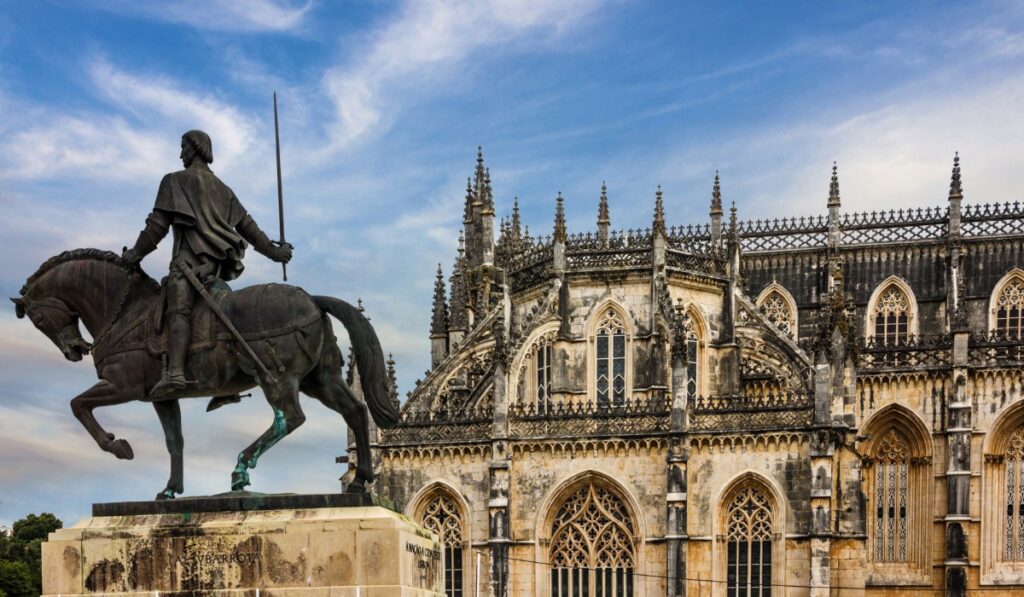
Day four begins with the roughly 30-minute drive from Alcobaça to Batalha. João I founded the Dominican monastery in thanksgiving for the Portuguese victory at Aljubarrota in 1385, a decisive event in securing his rule and Portugal’s independence from Castile. Visit the Founder’s Chapel, where João and Philippa of Lancaster lie together, then compare the Gothic church with the intricate Manueline decoration of the Unfinished Chapels.
Reserve a generous morning, with time to sit rather than continually move between rooms. Stone floors and open areas can be tiring for younger children and travelers with limited mobility. A local driver/guide can shape the day around the guests, adding the nearby Aljubarrota interpretation center or allowing a longer lunch. Continue about 45 minutes to Tomar and stay two nights.
5. Tomar’s Convent of Christ, best explored from a local base
Spend day five at the Convent of Christ, a UNESCO World Heritage Site that developed from a twelfth-century Knights Templar stronghold into the headquarters of the Order of Christ. Its extraordinary Charola, the round church at the heart of the complex, is the essential starting point. Later additions reveal centuries of changing tastes, culminating in the celebrated Manueline chapter-house window, dense with maritime and religious imagery.
Allow around three hours, and expect slopes, steps and substantial walking. Staying in Tomar means there is no long transfer after the visit. Descend to the old town for lunch, then stroll beside the Nabão River if energy allows. Look for regional dishes such as cabrito assado, roast kid, and wines from the Tejo region. Check opening days before fixing the overnight sequence.
6. Santa Clara-a-Velha, Coimbra’s encounter with a changing river
Drive roughly one hour from Tomar to Coimbra on day six. On the Mondego’s south bank, Santa Clara-a-Velha tells a different monastic story: repeated flooding eventually forced its Poor Clare community to relocate uphill. Queen Isabel, later canonized, supported the fourteenth-century monastery. The surviving Gothic church and archaeological remains explain how religious life depended on managing a difficult physical setting.
Confirm current access before traveling, since riverside conditions can affect visits. Use the afternoon for a gentle introduction to Coimbra rather than immediately climbing to the university. Stay two nights and try chanfana, goat slowly cooked with red wine, a specialty of the surrounding region. For Americans comparing European itineraries, these short transfers preserve time that longer cross-country routes consume.
7. Santa Cruz, Portugal’s first kings in Coimbra’s lower town
Visit Santa Cruz on day seven, pairing it with Coimbra’s historic center. Founded in 1131 for Augustinian canons, the monastery became an important intellectual and religious institution. Its church houses the tombs of Portugal’s first two kings, Afonso Henriques and Sancho I, reworked in elaborate Manueline style during the sixteenth century. This gives the journey a clear historical thread back to Alcobaça’s royal founder.
The lower-town location avoids an immediate uphill walk, though individual historic interiors may still present access challenges. Book the university’s Joanina Library separately if adding it later. Keep normal city precautions around busy streets and belongings. When comparing value with France, Italy or Spain, assess the complete itinerary, including hotel location, admissions and transfers, rather than assuming every Portuguese stop costs less.
8. Tibães, a quieter Benedictine finale near Braga
On day eight, allow roughly two and a half hours from Coimbra to São Martinho de Tibães, outside Braga. This former mother house of the Portuguese Benedictine congregation combines richly decorated church interiors with monastic spaces and enclosed grounds. Much of its present appearance dates from seventeenth- and eighteenth-century rebuilding. After the royal monuments farther south, Tibães offers a more secluded setting for considering everyday monastic organization.
Finish with lunch in Braga, perhaps bacalhau à Braga, fried salt cod with potatoes and an onion-based topping, before continuing to Porto for your final night. Portugal Magik’s Mercedes-Benz vehicles let travelers connect these places without handling unfamiliar roads or parking. The strongest monastery journey leaves room between monuments: eight days, regional meals and enough pauses to remember what made each place distinct.
Plan your own day
Share your dates, group size and interests, and we will suggest a tailored plan with a local driver/guide.