Plan an enriching multi-day stay in Coimbra focused on one of Europe’s oldest universities, medieval monasteries, and nearby historical highlights.
Setting the Scene in Portugal’s Medieval Capital
Rising sharply above the Mondego River, Coimbra holds a unique place in the national story. Before Lisbon took prominence, this city served as the medieval seat of Portuguese kings. Six monarchs were born within its borders, creating a dense urban fabric of fortified gateways, steep alleys, and religious houses that still define the historic core today.
Most travelers pass through Coimbra as a quick lunch stop between Lisbon and Porto, but giving the city three dedicated days allows you to peel back layers of academic heritage that date back to 1290. The city separates naturally into two parts: the high town, known as the Alta, where scholars have walked for centuries, and the low town, the Baixa, where merchants and river traders established bustling market streets. Exploring both at an unhurried pace reveals a distinct cultural identity shaped by generations of student life, literary traditions, and convent recipes.
Day One: The Royal Palace and the Joanina Library
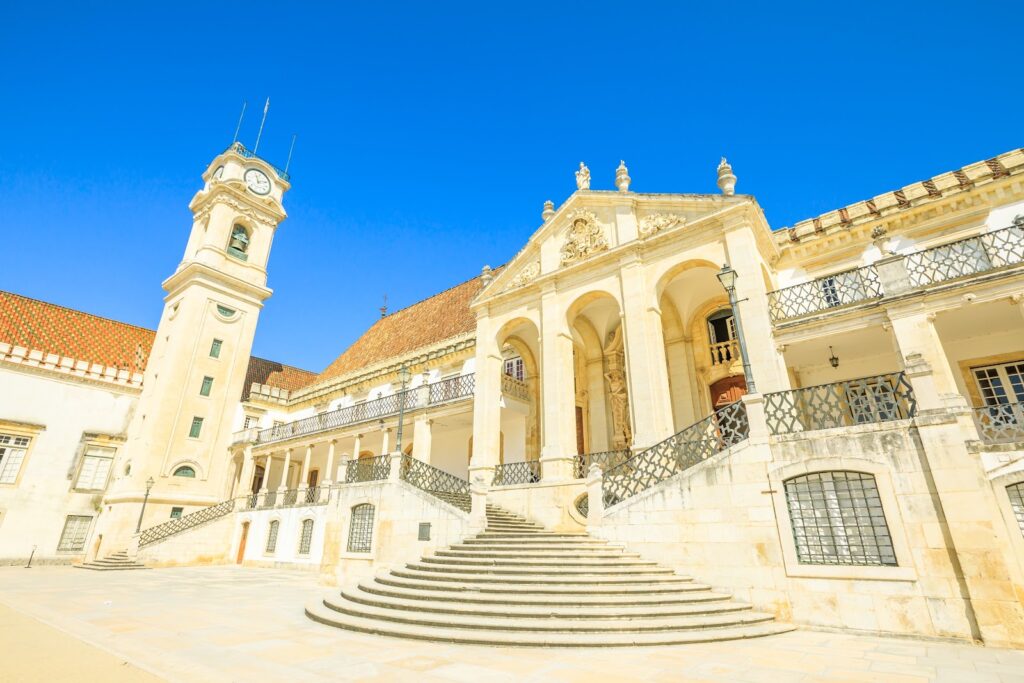
Begin your exploration at the crown of the city inside the University of Coimbra. Originally the Royal Palace of Alcacova, the University campus occupies prime ground overlooking the river valley. The historic courtyard, the Paco das Escolas, gives you panoramic vistas and an immediate sense of academic grandeur. Students wearing their traditional black capes, the trajes academicos, still hurry between classrooms here, keeping living customs alive in ancient hallways.
The undisputed jewel of the upper campus is the Biblioteca Joanina, constructed in the early eighteenth century under King Joao V. Stepping inside reveals three magnificent halls adorned with gilded woodwork, painted ceilings, and towering shelves of rosewood and ebony that house tens of thousands of rare leather-bound volumes. The building maintains a stable microclimate through thick outer walls and an unusual team of resident bats that protect the pages by eating wood-boring insects at night. After exploring the library, walk through the Sala dos Capelos, where doctoral defenses take place beneath portraits of Portuguese kings, and climb the university clock tower for a sweeping perspective over the terracotta rooftops.
Descending the Hill: Cathedrals, Cloisters and Fado Traditions
In the afternoon, make your way down the hillside along the cobbled lanes of the Alta. Stop first at the Se Velha, the Old Cathedral, built in the twelfth century. Resembling a fortified castle, this Romanesque church withstood military conflicts and remains one of the finest surviving examples of its architectural style in Portugal. The quiet Gothic cloister behind the main nave offers a tranquil space to rest before continuing downhill.
As dusk settles over Coimbra, the local music takes center stage. Unlike the Lisbon style of Fado, which arose among working-class port neighborhoods, Coimbra Fado developed exclusively among university students. It is traditionally sung by men wearing academic capes and features poetic lyrics about student romance, philosophical longing, and departure from the city. Enjoying an early evening performance at a dedicated cultural venue like Fado ao Centro connects the physical streets you walked during the day with the emotional folklore of the university.
Browse our travel inspiration for ideas, or tell us what kind of day you have in mind.
Day Two: Monasteries Across the River and Convent Sweets
Cross the Santa Clara Bridge to the western bank of the Mondego River for a morning focused on Portugal’s royal history. Here lies the Monastery of Santa Clara-a-Velha, founded in the late thirteenth century. Built directly beside the river, the original Gothic convent suffered centuries of repeated flooding from the Mondego until the nuns were forced to abandon it in the seventeenth century. Today, an award-winning archaeological site and museum display the recovered ruins, showing how stone vaults and arches survived under deep river silt.
Further up the western hill sits the Monastery of Santa Clara-a-Nova, commissioned to provide a dry refuge for the monastic community. Within its silver tomb rests Queen Saint Isabel, the beloved patron saint of Coimbra, renowned for her charity toward the poor. Afterward, return to the Baixa for lunch featuring traditional central Portuguese cooking, such as chanfana, a slow-roasted goat stew prepared in red wine inside unglazed clay pots. Finish your meal at a local pastelaria with a pastilha de Coimbra or an arrufada, sweet convent pastries flavored with cinnamon and lemon peel that have been baked locally for generations.
Day Three: Roman Ruins of Conimbriga and the Forest of Bucaco
A multi-day stay in Coimbra gives you the freedom to explore the rich countryside that surrounds the district. Traveling just ten miles south brings you to Conimbriga, one of the largest and most thoroughly excavated Roman settlements on the Iberian Peninsula. Walk along preserved residential streets to admire the House of the Fountains, where complex floor mosaics depicting mythological scenes, hunting parties, and geometric patterns remain vivid under open skies.
In the afternoon, travel northeast toward the National Forest of Bucaco. Enclosed by stone walls built by Carmelite monks in the seventeenth century, this mountain sanctuary contains hundreds of exotic tree species brought back during the Age of Discovery. At its center stands the Palace Hotel of Bucaco, a former royal hunting lodge designed in exuberant Neo-Manueline style. Traveling between these regional treasures in a climate-controlled Mercedes-Benz vehicle with Portugal Magik makes navigating regional roads effortless, as a knowledgeable local driver can shape the day around your personal interests without the stress of parking or mountain driving.
Practical Planning for an Unhurried Central Portugal Base
Coimbra is a city of steep gradients, with uneven limestone paving that rewards sensible walking footwear. The climb up the Quebra Costas, literally translated as the Backbreaker Street, connects the lower market squares to the university grounds and requires a steady pace. Reserving your timed entrance tickets for the Joanina Library well in advance is essential, as strict visitor caps preserve the historic humidity levels of the collection.
Spring and autumn bring mild temperatures and lively campus energy, as students are actively in session during these months. Because Coimbra sits halfway between Lisbon and Porto, pairing it with your broader Portuguese journey creates a balanced itinerary between bustling metropolises and academic heritage. Having a dedicated private driver and guide allows you to adjust stops as the weather or your energy dictates, transforming a historic crossroads into the centerpiece of your time in central Portugal.
Plan your own day
Share your dates, group size and interests, and we will suggest a tailored plan with a local driver/guide.