
Make Évora your base for Roman remains, prehistoric stones, hilltop villages and the open landscapes of the Alentejo. This four day plan groups nearby places together, leaving time for regional food and unhurried afternoons.
Plan the journey around one comfortable base
The Alentejo rewards a different rhythm from Lisbon: fewer stops, longer lunches and time to notice the cork oaks, olive groves and wheat fields between towns. For a first visit, allow four days and three nights, using Évora as your base. The drive from Lisbon generally takes around an hour and a half to two hours, depending on your starting point and traffic. Staying inside or near the city walls makes evening walks straightforward, although vehicle access and parking vary by property.
This itinerary gives Évora a full opening day, pairs prehistoric sites with Arraiolos on the second, heads east to Monsaraz on the third, and finishes with the marble towns northeast of the city. Portugal Magik can arrange the journey in Mercedes-Benz vehicles, with a local driver/guide shaping the day around the guests, whether that means more archaeology, a longer lunch or fewer walking stops. Spring and autumn usually suit this route particularly well; summer calls for early starts and sheltered afternoons.
Day 1: Read Évora through its streets
Arrive in Évora early enough to explore before lunch, leaving your main luggage at your accommodation if arrangements allow. Begin around Praça do Giraldo, the city’s central square, then walk uphill towards the cathedral. Built from the late 12th century onwards, the cathedral combines Romanesque and Gothic features. Its rooftop route, when open, offers a useful introduction to the surrounding plains, though the stairs make it unsuitable for some visitors.
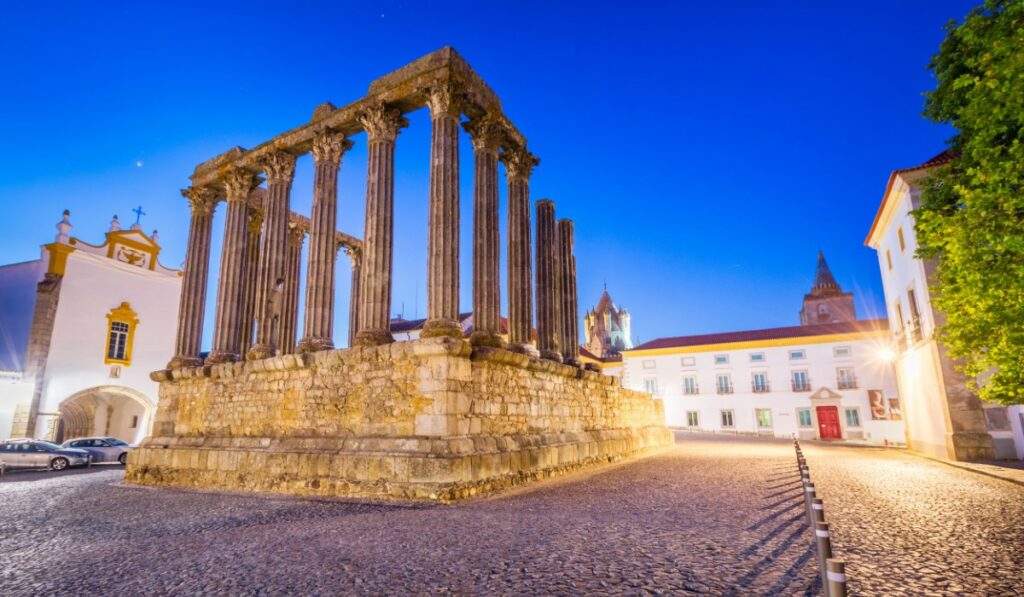
Nearby stands the Roman Temple, dating from the first century AD. Often called the Temple of Diana, it is more accurately understood in the context of the Roman imperial cult. The temple, cathedral and surrounding lanes fit naturally into one walking circuit rather than separate vehicle stops.
After lunch, continue to the Church of São Francisco and its adjoining Chapel of Bones, whose human remains form a deliberate reflection on mortality. Finish with a gentler walk along Rua do Cano, where houses sit beneath the arches of the Água de Prata aqueduct, completed in the 16th century. Check individual monument hours before fixing the sequence.
Day 2: Prehistoric landscapes and Arraiolos
Use the second morning for the countryside west of Évora. The Almendres Cromlech is one of the Iberian Peninsula’s most important megalithic complexes, with stones arranged over successive prehistoric phases. It is an outdoor archaeological landscape rather than a conventional museum visit: wear shoes with grip, carry water and expect uneven ground. Confirm current access arrangements and road conditions beforehand, particularly after rain, and allow more time than the short distance from Évora might suggest.
Continue towards Arraiolos for lunch and an afternoon focused on textiles and village streets. Its embroidered wool carpets have a longstanding connection with the town; the Arraiolos Carpet Interpretive Centre provides context before you browse local shops. Ask where individual pieces were made and how they were produced rather than assuming everything on display is locally stitched.
Walk up to the hilltop castle if temperatures and mobility allow. Its distinctive circular enclosure frames wide countryside views. Return to Évora for the night instead of adding another distant town, keeping this day flexible enough for a slower archaeological visit.
Browse our travel inspiration for ideas, or tell us what kind of day you have in mind.
Day 3: Pottery, Monsaraz and the Alqueva landscape
Head east through Reguengos de Monsaraz, making São Pedro do Corval your first substantial stop. The village is known for pottery, with workshops producing both practical earthenware and decorative pieces. Morning is a sensible time to visit, although workshop opening hours vary. Leave room in your luggage if you are drawn to painted bowls or serving dishes.
Continue to Monsaraz, a compact hilltop village with whitewashed houses, schist details and a castle overlooking the Guadiana borderlands. Park outside the historic core and explore on foot. The slopes and stone paving deserve sturdy footwear, and exposed viewpoints can feel particularly hot in summer.
Have lunch here or around Reguengos, then choose one afternoon focus. A prebooked winery visit near Reguengos suits wine enthusiasts, while a shorter excursion towards the Alqueva reservoir keeps attention on the landscape. Created by the dam on the Guadiana, the reservoir changed the region’s geography substantially. Avoid squeezing in both options if you want time to enjoy Monsaraz beyond a quick photograph.
Day 4: Marble towns before returning to Lisbon
Check out after breakfast and head northeast to Vila Viçosa, where marble appears in doorways, paving and major buildings. The Paço Ducal was a principal residence of the House of Braganza and makes the strongest historical anchor for the morning. Check tour arrangements and opening days in advance rather than assuming you can enter immediately on arrival.
Continue to nearby Borba for lunch, then spend the afternoon in Estremoz. These towns belong to the same marble-producing area, so the combination has a clear theme without requiring a succession of lengthy drives. In Estremoz, climb towards the upper town and castle precinct for views over the rooftops and farmland.
Estremoz also has a distinctive tradition of painted clay figures, recognised by UNESCO as intangible cultural heritage. Look for examples in local collections or artisan shops. On Saturdays, the market around Rossio Marquês de Pombal can justify reversing the day’s order. Allow roughly two hours for the onward drive to Lisbon, subject to traffic.
Make meals and seasonal conditions part of the plan
Alentejo food is a reason to protect lunchtime, not an extra to fit between monuments. Try açorda alentejana, a bread-based broth commonly flavoured with garlic and coriander, often served with egg, or migas, a substantial bread preparation frequently paired with pork. Lamb dishes, sheep’s milk cheeses and black pork are also worth seeking out. Finish with sericaia, a traditional egg dessert often accompanied by an Elvas plum.
Book winery visits and key meals ahead, especially at weekends. In summer, put exposed sites first and carry water even for short walks. If you have only three days, omit the marble towns rather than compressing every outing. With a fifth day, add a second Évora night for museums, shaded squares and a meal without an onward drive.
Plan your own day
Share your dates, group size and interests, and we will suggest a tailored plan with a local driver/guide.