Discover nine iconic Portuguese fortresses and royal residences that American travelers can effortlessly connect into a seamless, multi-day itinerary.
1. Pena Palace, the Romanticist Icon in Sintra
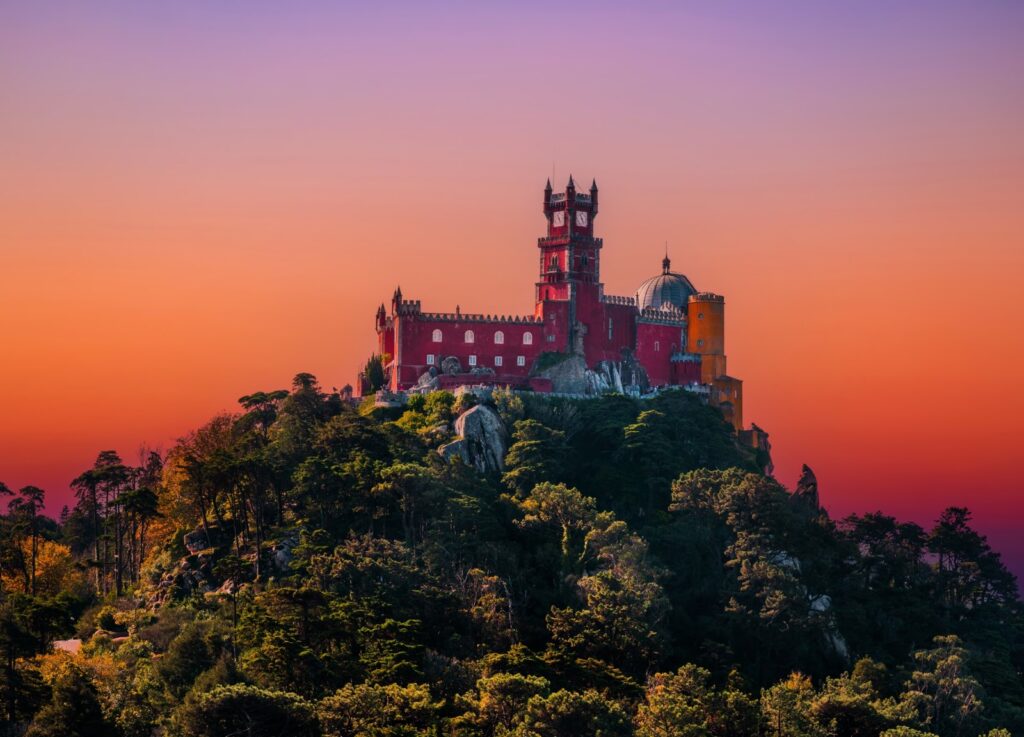
Pena Palace sits high above Sintra in the cool pine forests of the Serra. Commissioned in the nineteenth century by King Ferdinand II on the ruins of a Jerome monastery, it blends vivid yellow and red towers with Neo-Manueline, Gothic, and Moorish details. American visitors frequently compare its whimsical skyline to Neuschwanstein in Germany, yet Pena retains a distinct maritime spirit through stone carvings of coral, shells, and the mythic Triton guarding the main portal.
Visiting early in the morning lets you wander the terraced ramparts before afternoon mist or foot traffic rolls in. Because Sintra mountain roads are steep, narrow, and largely closed to unauthorized rental cars, having a knowledgeable driver drop you right at the upper gates saves substantial walking and avoids taxi queues. Pair the visit with a midday stop in the historic center to sample local travesseiro pastries filled with sweet almond cream.
2. Quinta da Regaleira, Secrets and Sunken Towers
Located just minutes from the village square in Sintra, Quinta da Regaleira offers a completely different atmosphere from Pena Palace. Built at the turn of the twentieth century by eccentric coffee magnate Antonio Augusto Carvalho Monteiro and Italian architect Luigi Manini, the estate includes a Gothic-Renaissance palace surrounded by dense mossy gardens filled with hidden tunnels, grottoes, and Masonic symbolism.
The centerpiece is the Initiation Well, a nine-tiered subterranean spiral staircase descending twenty-seven meters into the earth, symbolizing Dante’s circles of paradise and hell. American families and couples love exploring the stepping stones across green ponds and subterranean passages. It fits naturally into the afternoon of a dedicated Sintra day trip from Lisbon.
3. The National Palace of Queluz, the Portuguese Versailles
Set halfway between Lisbon and Sintra, the National Palace of Queluz served as an eighteenth-century summer residence for the royal family, most notably Queen Maria I and King Pedro III. Its delicate pink Rococo facade gives way to dazzling interior halls, including the Throne Room lined with gilded mirrors and crystal chandeliers, and the Ambassador Room paved with intricate marble. Outside, formal French parterres feature blue and white tile canals where royals once rode small boats during summer festivals.
Unlike Sintra, Queluz rarely sees overwhelming tourist crowds, making it ideal for American travelers seeking a serene look at Portuguese court life. It serves as an effortless morning stop on the journey out of Lisbon, leaving plenty of daylight to continue up the Atlantic coastline toward the seaside town of Cascais for fresh grilled sea bass by the ocean.
Browse our travel inspiration for ideas, or tell us what kind of day you have in mind.
4. Castelo de Sao Jorge, Guardian of Lisbon
Crowning the highest hill of Lisbon above the Alfama district, the Castle of Saint George traces its military roots to sixth-century Visigoths and eleventh-century Moors before the Christian reconquest led by King Afonso Henriques in 1147. Strolling along the shaded stone ramparts provides the finest panoramic view of Lisbon, looking down over terracotta rooftops, the broad Tagus River, and the suspension bridge.
The fortress grounds feature ancient pine trees, resident peacocks, and an archaeological site exposing Islamic-era residential quarters. Because parking around Alfama is almost nonexistent, navigating the base requires local street savvy. Starting your Lisbon explorations here gives you immediate geographic bearings across the seven hills before walking down toward the cathedral and riverfront taverns.
5. The Castle of Obidos, Medieval Walls on the Northern Route
Heading north from Lisbon toward Coimbra, the fortified village of Obidos commands attention from the highway. Encircled by towering crenelated stone walls gifted by King Denis to Queen Isabel of Aragon in the thirteenth century, the fortress castle is now an exceptional heritage property at the town’s highest point. Within the walls, whitewashed cottages with bright blue and yellow borders line cobbled lanes draped in flowering bougainvillea.
American travelers love Obidos for its compact walkability and vibrant small-town character. You can walk parts of the battlements, browse historic bookstores housed in former churches, and taste the famous ginjinha cherry liqueur served in edible chocolate cups. A private driver can shape the day around your pace, letting you visit Obidos mid-morning and continue to the coastal fishing town of Nazare for a beachside seafood lunch.
6. The Convent of Christ and Templar Castle in Tomar
Founded in 1160 by Gualdim Pais, Grand Master of the Knights Templar in Portugal, this formidable fortress and convent complex in Tomar is one of the most historically significant sites in Europe. The central highlight is the Charola, an octagonal Romanesque oratory designed after the Church of the Holy Sepulchre in Jerusalem, where armored knights could attend Mass while remaining mounted on horseback.
Later expansions under the Order of Christ added seven cloister courtyards and the world-famous Chapterhouse Window, a monumental stone sculpture of Manueline art filled with ropes, seaweed, and navigation instruments from Portugal’s Age of Discovery. Tomar makes an exceptional second-day stop on a central Portugal circuit, combining medieval military prowess with deeply peaceful convent gardens.
7. The Castle of Almourol, an Island Fortress on the Tagus
Rising dramatically from a granite outcrop in the middle of the Tagus River, the Castle of Almourol looks straight out of an Arthurian legend. Reconstructed by the Templars in 1171, it served as a defensive river redoubt along the border between Christian and Moorish territories. Visitors reach the island via a brief wooden skiff ride across the river waters, landing directly at the water gate beneath the central keep.
Because it sits halfway between Tomar and Lisbon, Almourol fits cleanly into a day exploring Templar country. American travelers appreciate that it feels wilder and far less commercial than grand palace estates. Climbing to the top of the keep rewards you with uninterrupted vistas of pine forests and the reflective river winding through the Ribatejo countryside.
8. The Royal Palace of Evora, Heart of the Alentejo
Two hours southeast of Lisbon across the rolling cork oak plains sits Evora, a UNESCO World Heritage city where Portuguese kings maintained court during the fifteenth and sixteenth centuries. The Palace of King Manuel, located inside the public gardens, features graceful Manueline-Mudéjar stone arches reflecting North African architectural influence. Just steps away stand the Corinthian columns of the first-century Roman Temple and the grand medieval cathedral.
Evora offers an unhurried, sunlit atmosphere that resonates with American travelers who value quiet exploration, excellent regional dining, and deep history. A dedicated day or overnight trip allows you to combine palace architecture with an authentic Alentejo dinner of slow-roasted black pork, wild asparagus, and full-bodied red wines from local vineyards.
9. Guimaraes Castle, the Cradle of the Nation
In the lush green valleys of northern Portugal near Porto, Guimaraes Castle stands as the symbolic birthplace of the Portuguese kingdom. Constructed in the tenth century to defend against Norse raids and Moorish incursions, it is traditionally celebrated as the birthplace of Afonso Henriques, the country’s first crowned monarch in 1128. Its massive square keep and sharp defensive towers overlook the neighboring Palace of the Dukes of Braganca, a fifteenth-century Burgundian-style estate with dozens of brick chimneys.
American travelers visiting Porto can easily dedicate a full day to Guimaraes and neighboring Braga. Wandering between the medieval fortress, the timbered halls of the Ducal Palace, and the granite plazas of the lower town offers a deep connection to northern heritage, safely away from heavy traffic and with English spoken warmly everywhere you go.
Plan your own day
Share your dates, group size and interests, and we will suggest a tailored plan with a local driver/guide.