
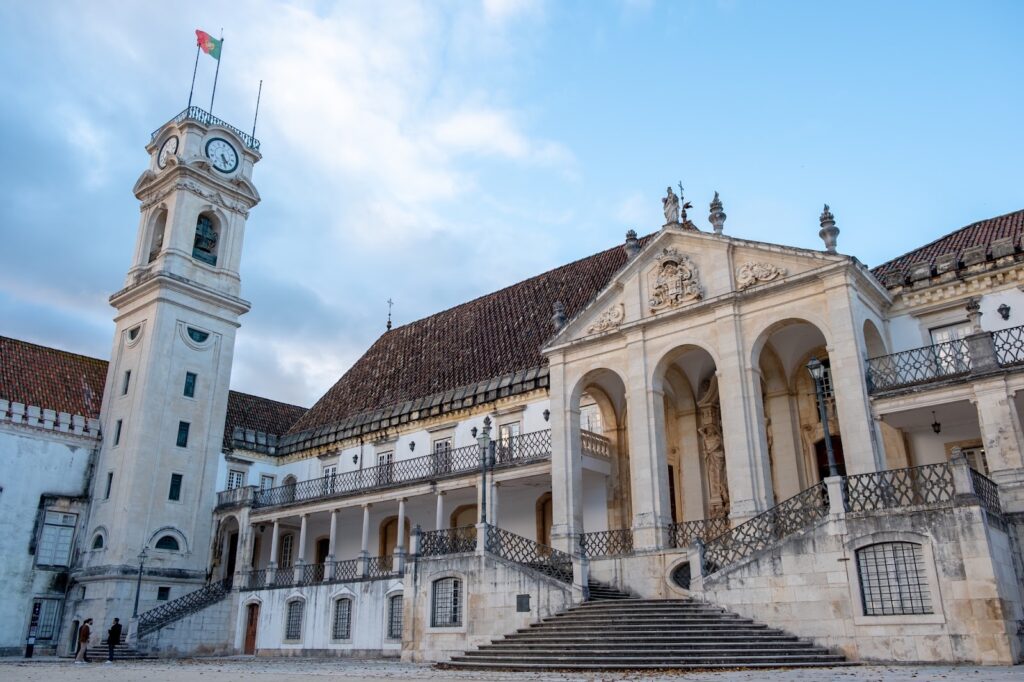
Give Coimbra four days and its university becomes part of a much larger story. This practical route connects scholarly landmarks with riverside monasteries, Roman Conímbriga and the wooded slopes of Buçaco.
Build the journey around three nights in Coimbra
Coimbra rewards a stay rather than a hurried stop between Lisbon and Porto. Its university crowns a steep hill above the Mondego, but the city’s history also unfolds through medieval churches, former convents and streets where students still gather. Plan three nights for the four-day route below, adding a fourth if you prefer to return to Coimbra after the final excursion.
The essential historical distinction is worth knowing before you arrive: King Dinis founded the university in Lisbon in 1290. It moved between Lisbon and Coimbra before settling permanently in Coimbra in 1537, under João III. The UNESCO property, University of Coimbra, Alta and Sofia, recognizes a scholarly landscape extending beyond the hilltop campus. Start with the lower city, give the university its own morning, then use the remaining days to explore the surrounding region.
Day 1: Arrive through the lower town and medieval Coimbra
Aim to arrive by lunchtime and begin around Praça do Comércio and the pedestrian streets of the Baixa. This puts cafés, shops and relatively level walking first, before tackling the upper town. Continue to the Monastery of Santa Cruz, founded in the 12th century, where Portugal’s first two kings, Afonso Henriques and Sancho I, are buried. Its royal connections help explain Coimbra’s importance long before the university settled here permanently.
After a break, pass through the Arco de Almedina and climb gradually towards the Sé Velha. The fortress-like Romanesque cathedral belongs to the city’s medieval chapter, with construction beginning in the 12th century. Cobbled slopes and steps make comfortable shoes more useful than an ambitious checklist. Save the university interiors for tomorrow rather than rushing uphill late in the afternoon.
For a sweet stop, look for pastéis de Santa Clara, pastries associated with Coimbra’s convent tradition and filled with egg yolk and almonds. Keep dinner near your accommodation, especially after a long arrival journey.
Day 2: Give the university time, then follow the river
Reserve the morning for the Paço das Escolas, the former royal palace that became the university’s ceremonial heart. The courtyard opens towards the Mondego, while the historic interiors reveal how royal authority, religion and learning overlapped. The Biblioteca Joanina, built in the early 18th century under João V, is the headline visit, with gilded woodwork and densely shelved books. Book the appropriate university ticket ahead, check which spaces it includes and follow the timed entry and photography rules.
Allow time for the Chapel of São Miguel and, when accessible under your chosen ticket, the Sala dos Capelos, used for major academic ceremonies. Access can change around university events. Afterwards, descend towards the Botanical Garden, established in 1772 during the educational reforms associated with the Marquis of Pombal. Its scientific purpose adds another layer to the university story beyond the ceremonial rooms.
After lunch, cross the Mondego to Santa Clara-a-Velha. The Gothic monastery’s history is inseparable from repeated flooding and the community’s eventual move uphill. Choose this as your main afternoon visit rather than adding several more interiors. If you want an evening performance, Coimbra’s distinctive song tradition is closely associated with university life; check current public programmes rather than assuming a performance runs every night.
Browse our travel inspiration for ideas, or tell us what kind of day you have in mind.
Day 3: Put Roman Conímbriga beside the rural landscape
Head south for Conímbriga, near Condeixa-a-Nova, roughly half an hour from Coimbra by road in ordinary traffic. This is a substantial archaeological site, not a quick photo stop. Give the mosaics, surviving streets, baths and domestic spaces a full morning, with time for the museum if open. The House of the Fountains is particularly memorable for its mosaics and water features, although access and operation should be checked on the day.
Conímbriga offers a useful contrast to yesterday’s university: here, the evidence concerns urban life in Roman Lusitania rather than medieval kingship or academic ceremony. Bring sun protection and water, since exposed areas can feel hot even when Coimbra’s shaded streets are comfortable.
Continue towards Rabaçal for lunch and a quieter countryside afternoon. Look for Queijo Rabaçal, a regional cheese made from sheep’s and goat’s milk. If archaeology remains a shared interest, check opening arrangements for the Roman villa of Rabaçal; otherwise, take an unhurried village stop and return to Coimbra. A local driver/guide can shape the day around the guests, balancing archaeological detail with shorter walks and a longer lunch.
Day 4: Leave through Luso, Buçaco and Mealhada
For the final day, turn north towards Luso and the Mata Nacional do Buçaco. This works particularly well when continuing to Porto, although the forest deserves a deliberate detour rather than a rushed stop between motorway stretches. Luso makes a convenient coffee break before the wooded roads climb towards Buçaco.
Choose a manageable forest walk around the former Carmelite convent and the exterior of the Palace Hotel do Bussaco. The palace’s elaborate Neo-Manueline architecture belongs to a much later period than the convent, giving the setting two distinct historical layers. Routes vary in gradient and surface, so select a walk according to weather and mobility rather than trying to reach every viewpoint.
Make Mealhada your lunch stop for leitão da Bairrada, roast suckling pig traditionally served with crisp skin, often accompanied by sliced orange and potatoes. Bairrada sparkling wine is a familiar pairing for those who drink. If returning to Coimbra, leave the afternoon open; if continuing north, avoid adding a winery visit unless you have arranged enough time.
Keep the transfers simple and the walking realistic
Coimbra’s compact historic centre can be demanding on foot. Choose accommodation with attention to vehicle access and gradients, not just distance from the university. A hilltop drop-off followed by a downhill walk can make the university day easier, but pedestrian restrictions mean a vehicle cannot reach every doorway.
Portugal Magik’s private driver and guided tours use Mercedes-Benz vehicles for transfers and regional excursions, connecting the walking-focused city days with Conímbriga and Buçaco. Confirm university reservations, monastery opening hours and luggage arrangements before departure. During academic celebrations such as Queima das Fitas, expect a different atmosphere and greater demand for accommodation. Keep one flexible afternoon in the plan: Coimbra is best understood with time to pause.
Plan your own day
Share your dates, group size and interests, and we will suggest a tailored plan with a local driver/guide.


