Link Portugal’s great monasteries over seven days from Lisbon to Porto, with manageable drives, regional meals and time to understand what you are seeing. This route pairs celebrated monuments with practical overnight bases rather than packing every day with departures.
1. Jeronimos Monastery, begin with two nights in Lisbon
Give Lisbon the first two days of your seven-day journey, visiting Jerónimos Monastery in Belém on the second morning rather than immediately after an overnight flight from America. Commissioned by King Manuel I in the early sixteenth century, it housed Hieronymite monks and became a monumental expression of Portugal’s maritime ambitions. The carved cloisters reward close attention, while the church contains the tombs of Vasco da Gama and Luís de Camões. Jerónimos and the nearby Belém Tower share UNESCO World Heritage status, although visiting both interiors is not necessary for a satisfying day.
Allow about two hours for the monastery, with additional time for queues, and check current ticket arrangements and church access separately. Follow with pastéis de Belém at the bakery that has sold them since 1837, then lunch nearby: grilled fish makes a welcome contrast to the rich custard pastry. English is widely spoken in Lisbon’s visitor-facing businesses, easing the first days abroad. Portugal Magik’s Mercedes-Benz vehicles make transfers straightforward, and a local driver/guide can shape the day around the guests, whether that means a longer lunch or less walking.
2. Alcobaca Monastery, make day three a royal love story
Leave Lisbon after breakfast on day three for Alcobaça, roughly 90 minutes away by road in normal conditions. Founded in 1153 under Portugal’s first king, Afonso Henriques, this Cistercian monastery presents a striking change from Belém’s elaborate decoration. Its vast Gothic church emphasizes height, proportion and relative austerity. The fourteenth-century tombs of King Pedro I and Inês de Castro introduce one of Portugal’s most enduring stories: Inês was killed before Pedro became king, and he later declared that they had married. Look closely at the carved figures rather than treating the tombs as merely a romantic photo stop.
Plan around two hours, including the monastic rooms if open, then have lunch before continuing to Batalha. Alcobaça’s pastry shops preserve the region’s enthusiasm for egg-rich sweets associated with convent traditions; cornucópias, crisp pastry cones filled with egg cream, are a local choice. For couples comparing this journey with France or Italy, the appeal is not a promised saving on every purchase. It is the opportunity to combine major architecture, regional food and short transfers without repeatedly changing hotels.
3. Batalha Monastery, stay nearby instead of rushing onward
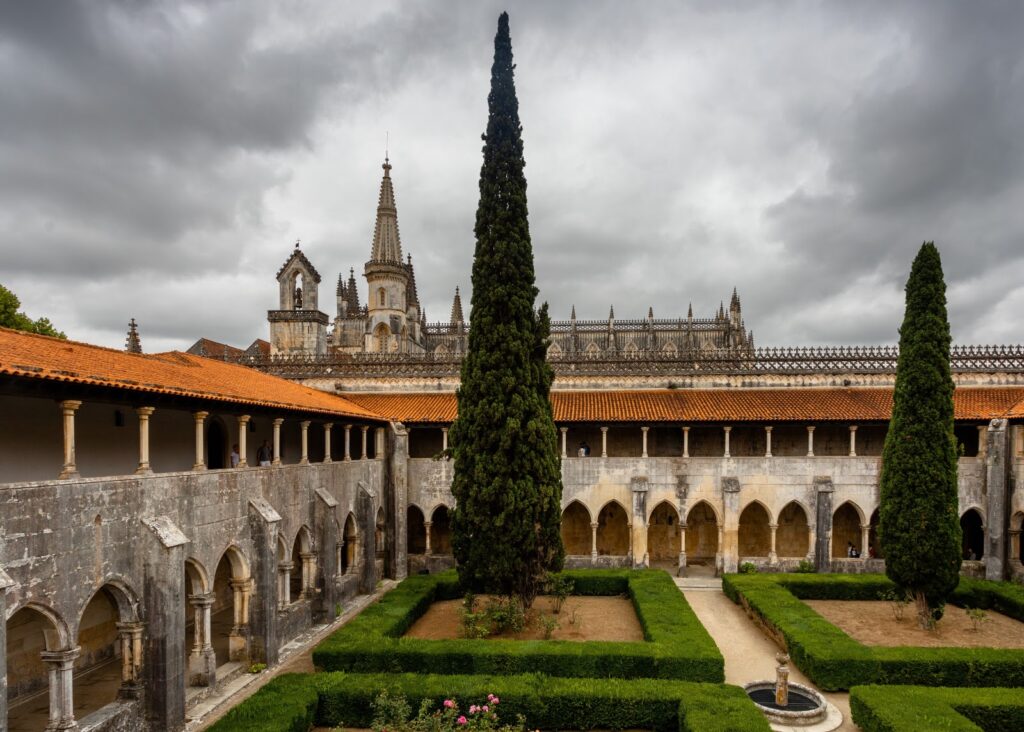
Batalha lies approximately 25 minutes from Alcobaça, making it a logical second visit on day three. João I founded the monastery to commemorate victory at the Battle of Aljubarrota in 1385, a decisive moment in securing Portuguese independence from Castile. Dominican friars occupied the complex. In the Founder’s Chapel, the tomb of João I and Philippa of Lancaster connects Portugal’s royal story with England, while the Unfinished Chapels reveal an extraordinary architectural project left open to the sky. Both Batalha and Alcobaça are individually UNESCO-listed monuments, but their atmosphere and decoration differ considerably.
Give Batalha about two hours and sleep in the town or nearby rather than adding another substantial drive. This makes the pairing comfortable for families and retirees, with a proper lunch separating the visits. The surrounding square also offers views of the exterior without another ticketed activity. Wear shoes with good grip, since polished stone and wet paving demand care. Portugal is generally a comfortable destination for independent-minded American visitors, but ordinary precautions with belongings still apply, especially at busy stops.
Browse our travel inspiration for ideas, or tell us what kind of day you have in mind.
4. Convent of Christ, devote day four to Tomar
From Batalha, allow roughly 45 minutes to reach Tomar on day four. The Convent of Christ is technically a convent complex rather than a monastery bearing that name, but it is essential to understanding Portugal’s religious orders. Founded by the Knights Templar in the twelfth century, the site later became the headquarters of the Order of Christ after the Templars were suppressed. Start with the Charola, the remarkable round church, then follow the architectural changes through the cloisters. The celebrated Manueline chapter-house window is dense with maritime and religious imagery.
Reserve at least two hours, or longer if architecture is a particular interest. There are slopes, steps and extensive stone surfaces, so discuss mobility needs before choosing a route through the complex. Spend the afternoon in Tomar’s lower town around Praça da República and the Nabão River, then stay overnight. For something sweet, look for fatias de Tomar, an egg-based specialty served in syrup. Leaving the driving to someone else also lets both partners enjoy a glass of wine from the Tejo region with dinner.
5. Santa Cruz Monastery, give Coimbra a full overnight
Drive approximately one hour from Tomar to Coimbra on day five. Santa Cruz Monastery, founded in 1131 for Augustinian canons, stands in the lower town and holds the tombs of Portugal’s first two kings, Afonso Henriques and Sancho I. Much of the decoration visible today reflects later rebuilding, particularly the Manueline work of the sixteenth century. This is a useful counterpoint to Alcobaça: instead of a vast isolated complex, you encounter a royal religious foundation embedded in a living city.
Allow around an hour, checking which spaces are accessible and respecting services in the church. Have lunch downtown before deciding whether to tackle Coimbra’s steep upper streets and university. Roast kid, cabrito assado, appears on regional menus and pairs well with a Dão red. An overnight prevents Coimbra becoming a hurried meal stop between monuments. It also gives travelers who prefer gentler pacing the option of an afternoon café while others explore uphill.
6. Serra do Pilar Monastery, finish with two days around Porto
On day six, continue from Coimbra to Vila Nova de Gaia, approximately 90 minutes by road. Serra do Pilar Monastery rises above the Douro opposite Porto. Begun in the sixteenth century for Augustinian canons, it is distinctive for its circular church and circular cloister. It forms part of the UNESCO-listed historic area encompassing Porto, the Luiz I Bridge and the monastery. Interior access can vary, so confirm arrangements rather than building the visit around an assumed tour; the public terrace itself provides an outstanding introduction to the riverfront.
Spend nights six and seven in Porto, leaving the final full day for the city’s streets, a scheduled port lodge visit in Gaia and an unhurried meal. Try tripas à moda do Porto, the city’s traditional tripe and bean dish, or choose grilled Atlantic fish. The climb to Serra do Pilar can be demanding, making road access helpful even for travelers happy to walk elsewhere. Taken together, these six stops create a coherent journey through royal foundations, religious orders and changing architecture, with enough breathing room for Portugal beyond the cloisters.
Plan your own day
Share your dates, group size and interests, and we will suggest a tailored plan with a local driver/guide.