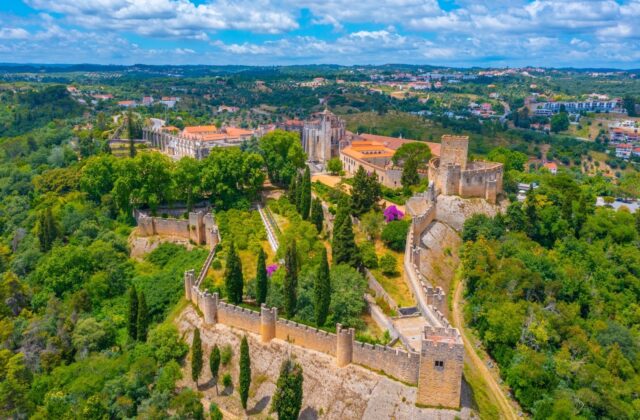
Beyond Porto, northern Portugal rewards a slower journey through river towns, fortified borders, mountain villages and vineyard country. Link these eight stops across eight or nine days, with time for proper lunches and fewer hotel changes.
1. Viana do Castelo, an Atlantic starting point
Begin with two nights in Viana do Castelo, about an hour north of Porto by road. Its historic center brings together Praça da República, the Renaissance fountain and the richly decorated Misericórdia building. Above town, the Sanctuary of Santa Luzia looks across the Lima estuary and Atlantic coastline. Visit the center first, then head uphill when visibility is good, rather than committing your clearest morning to an indoor attraction.
For lunch, look for arroz de sarrabulho only if your group enjoys hearty meat dishes; otherwise, coastal fish is the easier introduction. The Gil Eannes, a former hospital ship serving Portugal’s cod-fishing fleet, gives families a tangible maritime stop. Expect ladders and narrow passages aboard. English is commonly spoken in visitor-facing businesses, although a few Portuguese greetings remain useful in smaller restaurants.
2. Ponte de Lima, a river town worth an unhurried day
On day two, drive roughly 30 minutes inland to Ponte de Lima, returning to Viana for the night. The town received its charter from Teresa of León in 1125. Walk beside the Lima and cross its celebrated bridge, which combines Roman origins with substantial medieval construction. The riverside makes an agreeable contrast to the steep lanes Americans encounter in Porto, though cobbles still call for supportive shoes.
This is a particularly appropriate place for arroz de sarrabulho, rice cooked with pork blood and typically accompanied by assorted pork preparations. Order it to share if you are curious rather than certain. Pair lunch with a local Loureiro-based Vinho Verde. Its freshness suits the region better than treating every northern meal as an occasion for a powerful Douro red.
3. Valenca, border history without a rushed crossing
Leave Viana on day three and allow about 45 minutes to reach Valença. Its fortified enclosure overlooks the Minho River toward Tui in Spain. The defenses visible today largely reflect the military demands of the seventeenth and eighteenth centuries, rather than a single medieval building campaign. Spend the morning walking through the gates and between the two connected fortified areas, stopping at viewpoints over the international border.
Linen and household-textile shops occupy many of the old streets, making this a useful shopping stop without requiring a separate excursion. Rampart edges and uneven surfaces deserve attention, especially with young children. Continue around 25 minutes east to Monção for two nights. Keeping lunch on the Portuguese side avoids turning a satisfying border visit into a hurried attempt to cover two countries.
Browse our travel inspiration for ideas, or tell us what kind of day you have in mind.
4. Moncao, Alvarinho country with a palace detour
Use day four for Monção and its surrounding wine country. Monção and Melgaço form a Vinho Verde subregion particularly associated with Alvarinho, a grape capable of producing textured, ageworthy whites as well as bright young wines. Reserve a winery visit rather than assuming you can arrive without notice. With someone else handling the driving, both members of a couple can participate in the tasting.
Nearby Palácio da Brejoeira, an early nineteenth-century neoclassical estate, adds architecture and gardens to the wine-focused day; check current visiting arrangements before planning around its interiors. In town, seek out cordeiro à moda de Monção, a local lamb preparation associated with oven-baked rice. Restaurant meals and regional wines can offer compelling value, but compare actual menus rather than assuming every stop costs less than its French, Italian or Spanish counterpart.
5. Soajo, granite granaries on the mountain route
On day five, travel southeast toward Soajo, allowing roughly an hour from Monção depending on the route. Inside Peneda-Gerês National Park, the village is known for its communal group of stone espigueiros. These raised granaries, many topped with crosses, were built to protect stored crops from damp and animals. They are working agricultural heritage, not miniature chapels. Give the rocky setting time rather than treating it as a roadside photograph.
Have lunch locally, perhaps choosing regional beef where available, then continue to Guimarães for two nights. Allow around 90 minutes for that onward drive and more with stops. A local driver/guide can shape the day around the guests, choosing a short village walk for mixed generations or adding scenery when everyone has the energy. Mountain roads are winding, so this is not the day for a tightly timed dinner reservation.
6. Guimaraes, Portugal’s beginnings beyond a castle photograph
Give day six to Guimarães rather than squeezing it between wine tastings. Its UNESCO-listed historic center preserves a remarkably coherent medieval urban fabric. Start around Largo da Oliveira and Praça de São Tiago, then work uphill toward the castle and the Palace of the Dukes of Braganza. The city is closely associated with Afonso Henriques, Portugal’s first king, and the formation of the Portuguese kingdom.
The palace dates to the fifteenth century, but its appearance also reflects extensive twentieth-century restoration, a useful distinction for experienced European travelers. Break sightseeing with lunch and a pastry stop for tortas de Guimarães, traditionally made with ingredients including almonds and squash preserve. Central lanes suit exploration on foot; arrange vehicle pickup outside the oldest streets instead of expecting door-to-door access everywhere.
7. Amarante, a leisurely bridge between Minho and the Douro
On day seven, drive about 45 minutes from Guimarães to Amarante. The São Gonçalo church and bridge frame the Tâmega River, while the bridge carries memories of resistance during the 1809 French invasion. Visit the church, walk the riverfront and leave time for the Museu Municipal Amadeo de Souza-Cardoso, named for the modernist artist born nearby. Check museum opening days before fixing the sequence.
Amarante deserves lunch rather than just a coffee stop. Try a regional meat dish followed by convent-influenced sweets such as papos de anjo. Afterward, continue approximately an hour to Lamego for two nights. This breaks the transfer into two manageable drives and gives travelers who already know Tuscany or Burgundy a different rhythm: compact historic towns between wine landscapes, without driving themselves.
8. Lamego, a final base for steps, art and vineyard country
Spend day eight in Lamego, beginning at the Sanctuary of Nossa Senhora dos Remédios. Its monumental stairway has more than 600 steps; visitors who prefer not to climb can approach the upper sanctuary by road. Below, the cathedral and Museu de Lamego add depth, including paintings by the sixteenth-century master Vasco Fernandes. Look for local presunto and wines from the surrounding Távora-Varosa region, known particularly for sparkling production.
Add a ninth day for a reserved Douro winery visit near Peso da Régua rather than forcing it into the museum afternoon. Portugal Magik’s private tours in Mercedes-Benz vehicles make this sequence possible without managing parking or mountain navigation. The best closing decision is simple: retain a free afternoon. Northern Portugal is more rewarding when a long lunch does not mean missing the next appointment.
Plan your own day
Share your dates, group size and interests, and we will suggest a tailored plan with a local driver/guide.